 Admin
Admin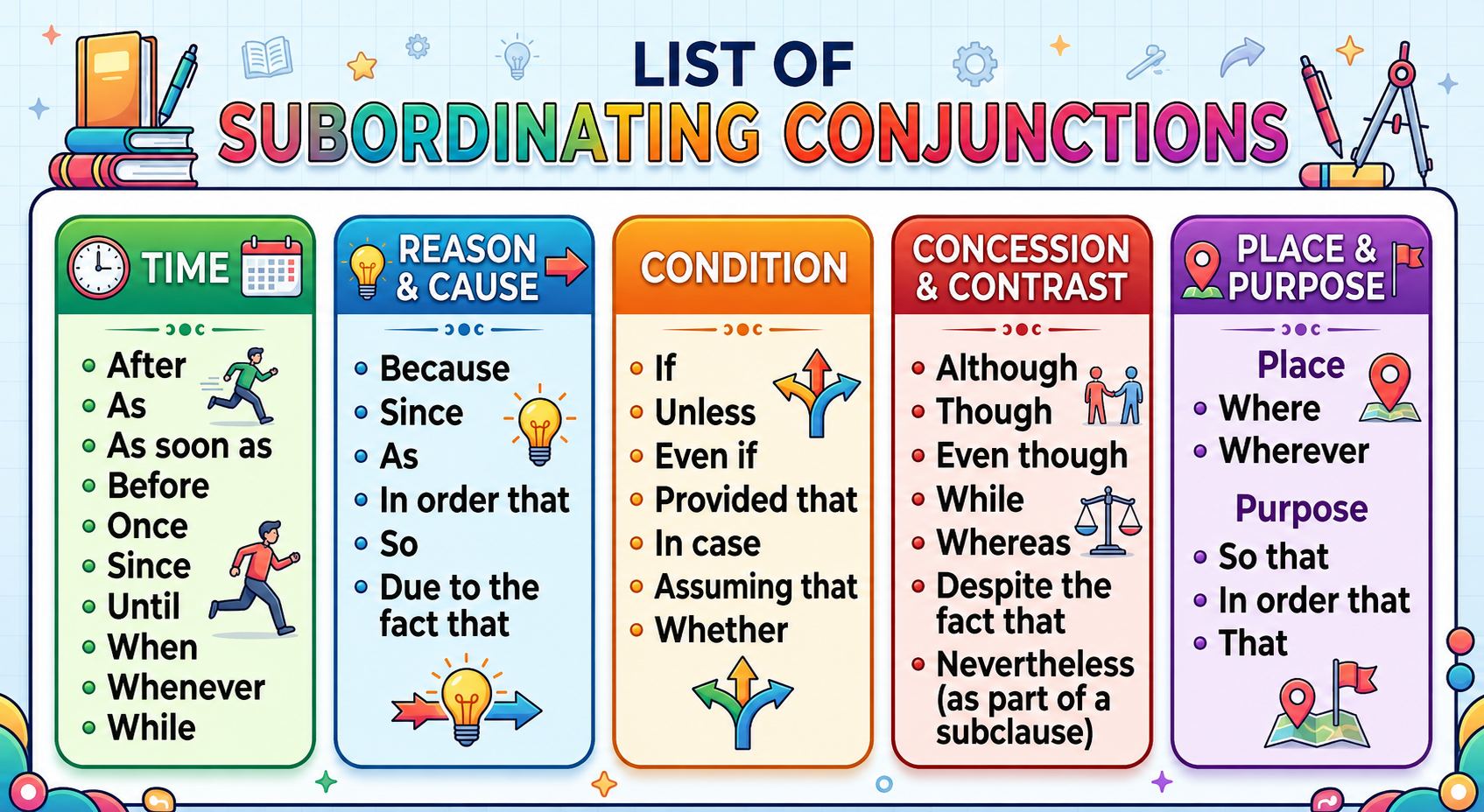
The subordinating conjunctions list is an important part of English grammar because it helps learners understand how to connect ideas in a clear and meaningful way. Subordinating conjunctions are words that join a dependent clause with an independent clause, creating a complete and logical sentence. These words show relationships such as time, cause, condition, contrast, and purpose, which makes writing more detailed and easier to understand. Without subordinating conjunctions, sentences often feel short, disconnected, and less expressive, which can reduce clarity in communication.
Learning the subordinating conjunctions list is especially useful for students and writers who want to improve their grammar and sentence structure. Common examples include words like because, although, if, when, and since, which are frequently used in both academic writing and everyday conversation. These conjunctions allow writers to explain reasons, show conditions, or describe timing in a smooth and natural way. By mastering them, learners can improve their writing fluency, create more complex sentences, and communicate ideas more effectively in both spoken and written English.
Types of Subordinating Conjunctions (Time, Cause, Condition, Contrast)
Subordinating conjunctions can be grouped into different types based on the relationship they show between ideas. One of the most common categories is time, which includes words like when, before, after, while, and until. These conjunctions help explain when an action happens in relation to another action. For example, they allow writers to describe sequences of events clearly, making sentences more structured and easier to follow. Time-based subordinating conjunctions are widely used in storytelling, instructions, and everyday communication.
Another important category includes cause, condition, and contrast. Cause-related conjunctions such as because, since, and as explain the reason behind an action. Condition conjunctions like if, unless, and provided that show requirements or situations that must be met. Contrast conjunctions such as although, though, and whereas highlight differences between two ideas. These categories help writers express complex relationships between ideas, making their communication more precise, meaningful, and logically connected.
Full Subordinating Conjunctions List with Examples
The subordinating conjunctions list includes a wide range of words that help connect dependent and independent clauses in English sentences. These conjunctions are used to show time, reason, condition, contrast, and purpose, making them essential for building complex and meaningful sentences. Some of the most commonly used subordinating conjunctions include after, although, as, because, before, if, since, though, unless, until, when, whenever, where, whereas, and while. Each of these words plays a specific role in linking ideas smoothly and clearly.
For example, subordinating conjunctions are used in sentences like “I stayed home because it was raining,” “She smiled although she was tired,” and “You can go out if you finish your homework.” In each case, the conjunction connects two ideas and shows the relationship between them. Without these words, sentences would become short and disconnected, making it harder for readers to understand the intended meaning. By practicing the subordinating conjunctions list, learners can improve their ability to write clear, structured, and more professional English sentences.
How Subordinating Conjunctions Work in Sentences
Subordinating conjunctions play an important role in forming complex sentences by linking a dependent clause to an independent clause. The subordinating conjunctions list helps learners understand how these words control the relationship between two ideas, such as showing time, reason, condition, or contrast. A dependent clause cannot stand alone because it does not express a complete thought, so it relies on the main clause for meaning. For example, in the sentence “I went to sleep when I felt tired,” the word when connects both ideas and shows the timing of the action.
These conjunctions also help improve sentence flow and clarity by making writing more natural and connected. Without them, ideas would appear broken or unrelated. For instance, instead of writing “It was raining. I stayed inside,” we can use a subordinating conjunction to form a smoother sentence: “I stayed inside because it was raining.” This not only improves readability but also adds depth to communication. Mastering the subordinating conjunctions list allows writers to express complex ideas more effectively and enhances overall grammar skills in both academic and everyday writing.
Common Mistakes and How to Avoid Them
Many learners struggle with the correct use of the subordinating conjunctions list, often making mistakes that affect sentence clarity. One common error is using a dependent clause on its own without an independent clause. For example, writing “Because I was tired” is incomplete because it does not express a full idea. A correct version would be “I slept early because I was tired.” Another frequent mistake is misplacing the conjunction, which can make sentences confusing or grammatically incorrect. Proper sentence structure is essential to ensure that ideas are connected clearly and logically.
Another mistake involves overusing or misusing subordinating conjunctions in a single sentence. Some learners try to add too many ideas together, which can make writing difficult to understand. For instance, combining multiple conjunctions without proper structure can lead to long, unclear sentences. To avoid these issues, it is important to practice using one clear subordinating conjunction at a time and ensure that each sentence has a complete idea. By carefully studying the subordinating conjunctions list and practicing correct sentence formation, learners can significantly improve their writing accuracy and communication skills.
Importance in Writing and Communication Skills
The subordinating conjunctions list plays a vital role in improving writing quality and overall communication skills. These conjunctions help writers connect ideas in a logical and structured way, making sentences more meaningful and easier to understand. In academic writing, subordinating conjunctions allow students to explain reasons, conditions, and contrasts clearly, which improves the depth and clarity of their arguments. Without them, writing may appear fragmented and less professional, reducing its overall impact on the reader.
In everyday communication as well, subordinating conjunctions make speech and writing more natural and fluent. They help express complex thoughts in a simple and organized manner, such as explaining why something happened or when it occurred. For example, instead of short, disconnected statements, people can create smooth sentences that sound more polished and effective. Mastering the subordinating conjunctions list not only enhances grammar accuracy but also strengthens confidence in both spoken and written English, making communication more powerful and expressive.
Practice Examples and Real-Life Usage
Practicing the subordinating conjunctions list is essential for mastering how these words function in real communication. In everyday English, subordinating conjunctions appear frequently in conversations, academic writing, storytelling, and even professional emails. They help connect ideas smoothly and show clear relationships between actions, such as time, reason, or condition. For example, people naturally say sentences like “I will call you when I arrive,” or “She stayed quiet because she was nervous,” without even thinking about the grammar rules behind them. This shows how deeply these conjunctions are embedded in daily language use.
In writing practice, learners can improve their skills by creating their own sentences using different subordinating conjunctions from the list. For instance, combining ideas such as “Although it was late, we continued working” or “If you study regularly, you will improve your grammar” helps strengthen understanding of sentence structure. Teachers often encourage students to rewrite simple sentences into complex ones using subordinating conjunctions to build fluency. Regular practice with the subordinating conjunctions list not only improves grammar accuracy but also enhances creativity and confidence in both spoken and written English.
Conclusion
In conclusion, the subordinating conjunctions list is an essential part of English grammar that helps connect ideas and build meaningful, structured sentences. These conjunctions improve writing by linking dependent and independent clauses and showing relationships such as time, cause, condition, and contrast. By using words like because, although, if, and when, writers can express thoughts more clearly and make their communication more natural and effective. Understanding how these conjunctions work allows learners to move beyond simple sentences and develop more advanced writing skills.
Overall, mastering the subordinating conjunctions list is valuable for students, writers, and English learners who want to improve both academic and everyday communication. With regular practice, learners can avoid common mistakes, enhance sentence variety, and express ideas with greater clarity and confidence. Strong command of subordinating conjunctions not only improves grammar accuracy but also strengthens overall language proficiency, making communication more impactful and professional.
FAQs
What is a subordinating conjunction?
A subordinating conjunction is a word that connects a dependent clause to an independent clause to form a complete sentence.
What is included in the subordinating conjunctions list?
The list includes words like because, although, if, when, since, until, and many others that show time, reason, condition, or contrast.
Why are subordinating conjunctions important?
They are important because they help create clear, connected, and meaningful sentences in both writing and speaking.
Can a sentence start with a subordinating conjunction?
Yes, a sentence can start with a subordinating conjunction as long as it is followed by a complete main clause.
Visit for More information : Multiple Magazines