 Admin
Admin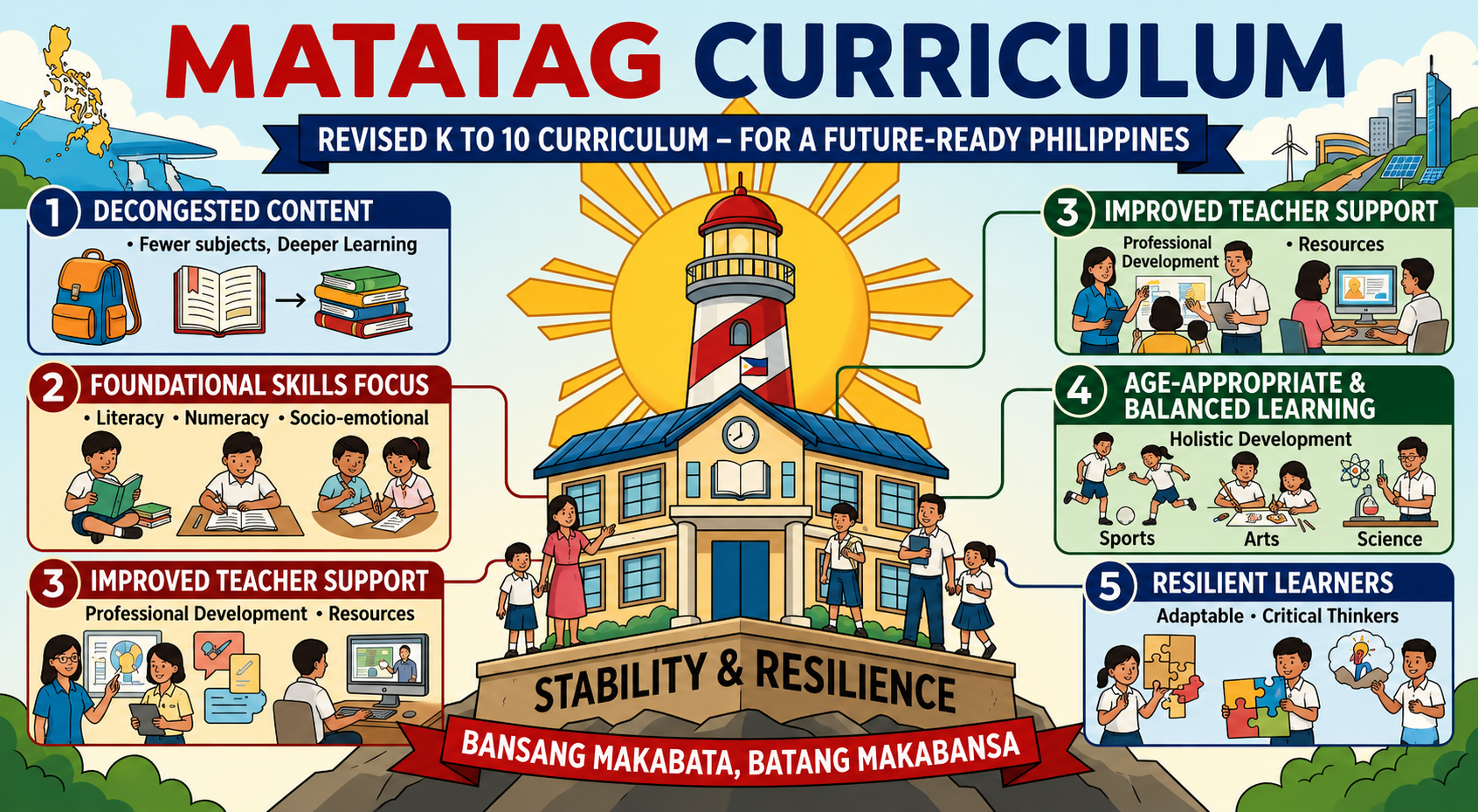
The Department of Education (DepEd) in the Philippines developed the matatag curriculum as an updated basic education framework to improve the quality of learning in schools. DepEd introduced it in response to long-standing issues in the education system, such as overloaded subjects, low reading comprehension levels, and weak performance in international assessments. Instead of overwhelming students with too many topics, the curriculum focuses on essential skills that learners need to build a strong academic foundation. These include literacy, numeracy, critical thinking, and values formation, which support both academic success and real-life application.
DepEd introduced the matatag curriculum to make learning more meaningful, focused, and effective for students from Kindergarten to Grade 10. DepEd recognized that many learners struggle to fully understand lessons because of the heavy volume of content in the previous curriculum. By reducing unnecessary competencies and reorganizing subject areas, the new system gives teachers more time to ensure students master each topic before they move forward. This approach improves overall learning outcomes, reduces student stress, and better prepares learners for higher education and future careers.
Key Features of the Matatag Curriculum
The matatag curriculum introduces several important features that improve the quality and effectiveness of basic education in the Philippines. One of its main features reduces learning competencies, so students no longer need to cover an overwhelming number of topics in a short time. Instead, the curriculum focuses on essential skills that learners must master at each grade level. It strengthens foundational abilities in reading, writing, mathematics, and values education. By simplifying the learning load, the system allows teachers to give more attention to ensuring students fully understand each lesson before they move forward.
Another key feature of the matatag curriculum is its stronger emphasis on skill-based and values-based learning. The curriculum promotes critical thinking, problem-solving, and real-world application of knowledge rather than memorization alone. It also integrates values formation more deeply into everyday learning to help shape responsible and well-rounded students. In addition, the curriculum organizes subjects more clearly and sequences lessons better, making it easier for both teachers and students to follow. These improvements create a more balanced, focused, and effective learning experience across all grade levels.
Subjects and Learning Changes in the New System
The matatag curriculum introduces important changes in subjects and learning structure to make education more focused and effective. Instead of covering a large number of topics, it reorganizes subjects to prioritize essential learning areas. It strengthens core subjects such as language, mathematics, science, and values education to ensure that students build strong foundational skills. It also streamlines and integrates some subjects to avoid repetition and reduce the overall workload for both teachers and learners. This change gives more time for understanding concepts deeply rather than rushing through lessons.
In terms of learning changes, the matatag curriculum shifts from memorization-based learning to more skill-oriented education. It encourages students to apply knowledge in real-life situations, think critically, and solve problems independently. The curriculum designs lessons with clearer progression so learners can gradually build understanding from simple to more complex concepts. Teachers also benefit from improved lesson sequencing, which helps them deliver instruction more effectively. Overall, these changes create a more meaningful and balanced learning experience that better prepares students for future academic and career challenges.
Benefits of the Matatag Curriculum for Students
The matatag curriculum offers several benefits aimed at improving the overall learning experience of students in the Philippines. One of the most important advantages is a lighter and more focused academic load. By reducing unnecessary topics and emphasizing essential competencies, students are able to understand lessons more clearly without feeling overwhelmed. This allows them to spend more time mastering core skills such as reading comprehension, numeracy, and critical thinking, which are crucial for long-term academic success.
Another key benefit of the matatag curriculum is its focus on meaningful and skill-based learning. Instead of relying heavily on memorization, students are encouraged to apply what they learn in real-life situations. This approach helps improve problem-solving abilities and builds confidence in using knowledge practically. It also supports better classroom engagement, as lessons are designed to be more relevant and easier to understand. Overall, the curriculum aims to create a stronger foundation for students, helping them perform better not only in school but also in future educational and career paths.
Challenges in Implementation
The matatag curriculum brings several improvements to the education system, but its implementation also comes with challenges that schools and teachers must address. One of the main challenges is the transition period, where educators need time to fully understand and adapt to the new curriculum structure. Teachers must undergo training and adjust their teaching strategies to match the revised learning competencies. This process can take time, especially in schools with limited resources or large class sizes, making smooth implementation more difficult in some areas.
Another challenge of the matatag curriculum is the availability of learning materials and support systems. Since the curriculum is newly introduced, not all schools may have immediate access to updated textbooks, guides, and teaching tools. This can create inconsistencies in how lessons are delivered across different regions. In addition, ensuring that all students benefit equally from the new system requires strong coordination between DepEd, teachers, and local education authorities. Despite these challenges, continuous support and proper implementation strategies are expected to improve the effectiveness of the curriculum over time.
Comparison with the Previous K–12 Curriculum
The matatag curriculum differs significantly from the previous K–12 curriculum in terms of focus, structure, and learning approach. The earlier K–12 system included a wide range of competencies and topics, which often resulted in an overloaded curriculum for both teachers and students. While it aimed to provide comprehensive education, many learners struggled to fully grasp lessons due to the volume of content. In contrast, the matatag curriculum reduces unnecessary topics and prioritizes essential skills, making learning more focused and manageable.
Another major difference lies in how learning is delivered. The previous K–12 curriculum was more content-heavy and often emphasized coverage over mastery. The matatag curriculum, however, places greater importance on understanding, skill development, and application of knowledge in real-life situations. It also improves subject organization and sequencing to ensure smoother learning progression. This shift represents a move toward quality over quantity, aiming to strengthen foundational education and improve student performance in the long term.
Future Impact on Philippine Education
The matatag curriculum is expected to have a long-term impact on the Philippine education system by strengthening the quality of basic education. As the curriculum focuses more on essential skills such as literacy, numeracy, and critical thinking, students are likely to develop a stronger academic foundation. This improvement can lead to better performance in higher education and international assessments over time. By prioritizing mastery over memorization, the system aims to produce learners who are more confident and capable in solving real-world problems.
In the future, the matatag curriculum may also help reduce educational gaps across different regions of the country. With a more streamlined and standardized approach, schools can deliver more consistent learning outcomes regardless of location. Teachers are also expected to benefit from clearer lesson structures, allowing them to teach more effectively. If properly implemented and supported with adequate resources, the curriculum has the potential to create a more balanced, inclusive, and competitive education system in the Philippines.
Conclusion
In conclusion, the matatag curriculum represents a significant reform in the Philippine education system designed to improve the quality of learning from Kindergarten to Grade 10. By reducing overloaded lessons and focusing on essential competencies, it aims to strengthen students’ foundational skills in literacy, numeracy, and critical thinking. This shift from quantity to quality helps learners understand concepts more deeply while reducing academic pressure. Overall, the curriculum is designed to create a more effective and meaningful learning experience that better prepares students for higher education and future careers.
FAQs
What is the main goal of the Matatag Curriculum?
Its main goal is to improve basic education by focusing on essential skills and reducing unnecessary learning topics.
Who created the Matatag Curriculum?
It was developed by the Department of Education (DepEd) in the Philippines.
What makes it different from the K–12 curriculum?
It reduces overloaded lessons and emphasizes mastery of core skills instead of covering too many topics.
When is the Matatag Curriculum implemented?
It is being implemented gradually across different grade levels starting in recent school years.
Visit for More information : Multiple Magazines