 Admin
Admin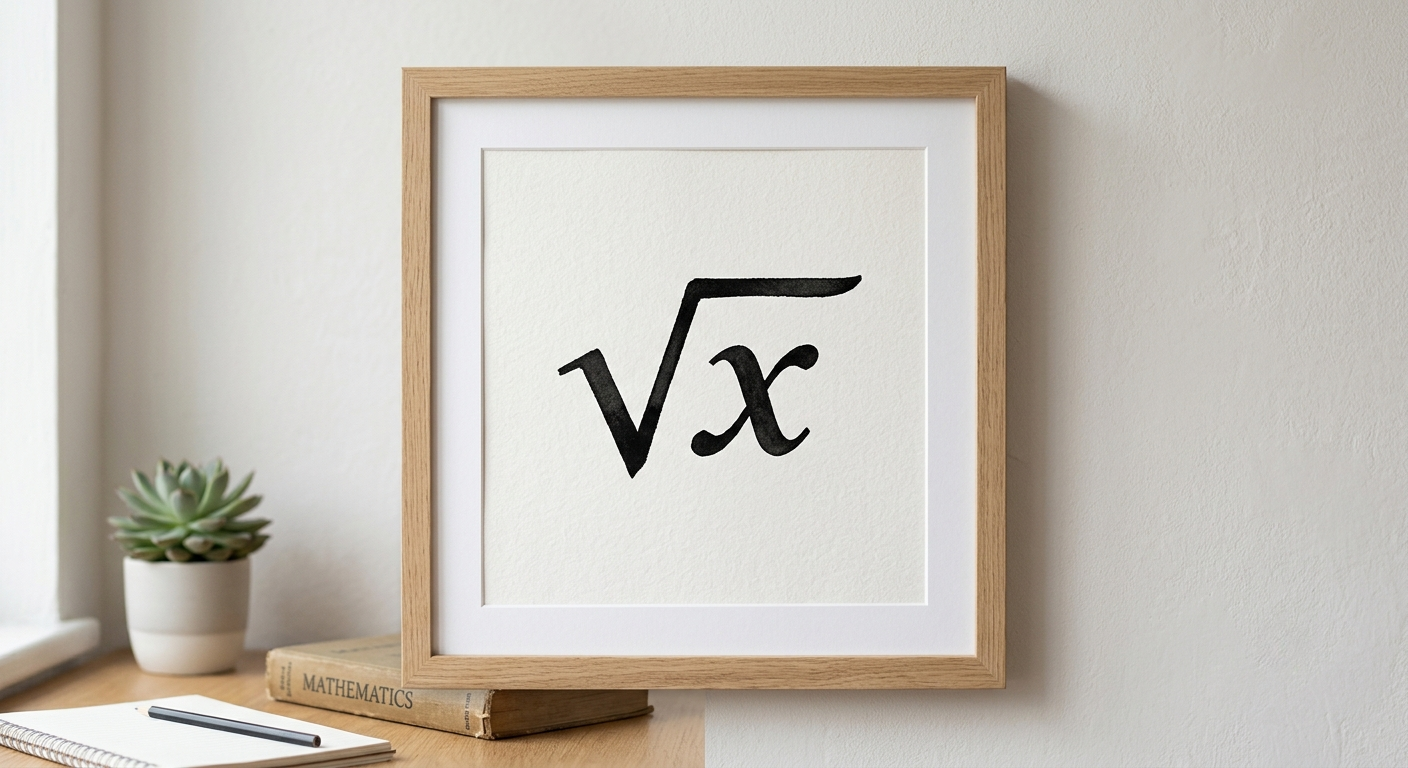
The square root symbol (√) shows the operation of finding a number that produces a given value when multiplied by itself. In simple terms, it answers the question: “Which number, when multiplied by itself, gives this result?” For example, √16 equals 4 because 4 × 4 equals 16. This makes the square root symbol an essential part of basic and advanced mathematics, helping students and professionals simplify expressions and solve numerical problems efficiently.
The square root symbol also appears widely in algebra to represent unknown values. Instead of writing long explanations, mathematicians use √x to show a number whose square equals x. This notation makes equations shorter, clearer, and easier to understand. It is commonly used in geometry, physics, and engineering where calculations often involve squared values that require reversal using square roots.
History and Mathematical Importance of √
The square root symbol (√) has a long history that dates back to early European mathematics. Mathematicians first popularized it in the 16th century when they began developing standardized notations to simplify complex calculations. Before the symbol existed, they wrote square roots in words, which made mathematical expressions longer and harder to interpret. The introduction of √ brought clarity and efficiency to mathematical writing and made it easier to solve and communicate equations.
Over time, the square root symbol became a fundamental part of modern mathematics, and education and scientific fields now use it worldwide. Its importance lies in its ability to simplify calculations involving squared numbers, which appear frequently in algebra, geometry, physics, and engineering. Today, people recognize the symbol universally, and it plays a key role in solving equations, analyzing data, and understanding mathematical relationships across different disciplines.
How to Use the Square Root Symbol in Math
The square root sign (√) finds a number that, when multiplied by itself, gives the original value. In practical terms, it reverses squaring. For example, if x² = 49, then applying it gives √49 = 7. This operation appears widely in algebraic equations, geometry problems, and scientific calculations where people need to find missing values.
In algebra, people often use this symbol with variables and expressions, such as √x or √(x + 9). It simplifies equations and makes problem-solving more efficient. In geometry, it appears commonly in the Pythagorean theorem to find missing sides of right-angled triangles. Because of its versatility, this symbol serves as one of the most essential tools in mathematical problem-solving across different fields.
Real-Life Examples
The square root sign (√) is not limited to textbooks; people widely use it in real-life situations where measurements and calculations are required. For example, architects use it when calculating distances, building dimensions, and structural stability. In construction, it helps determine diagonal lengths and ensures accurate design planning. A common real-life example involves using it in the Pythagorean theorem to calculate the shortest distance between two points.
In science and engineering, people apply this mathematical concept in formulas related to physics, motion, and energy. For instance, it helps calculate speed, force, and statistical data analysis. Even in finance and data science, it measures variability and risk. These practical applications show that this symbol is not just a mathematical concept but a powerful tool used in many professional fields every day.
Square Root Symbol in Digital Devices and Typing Methods
The square root sign (√) appears widely across digital devices, but people type it differently depending on the platform. On Windows computers, users insert it using the Alt code method, while Microsoft Word or Google Docs provides it through the symbol or equation menu. On smartphones, users access it through the symbols keyboard or mathematical input tools. These methods make it easy for students and professionals to use it in digital documents, assignments, and presentations.
In programming and online platforms, developers often represent it differently, such as using functions like sqrt() instead of the actual √ sign. This approach ensures compatibility across different systems and coding languages. Despite these variations, the meaning stays the same: calculating the value that, when multiplied by itself, produces the original number. Understanding how to type and use it digitally plays an important role in today’s technology-driven world.
Common Mistakes When Using the Square Root Symbol
Many learners make mistakes while using the square root symbol (√), especially when dealing with negative numbers and algebraic expressions. A common error is forgetting that the square root of a number should represent only the principal (positive) value. For example, √16 is 4, not ±4 in basic operations, unless specified in equation solving. Another frequent mistake is misapplying the symbol to expressions without simplifying them first, which can lead to incorrect results.
Another issue occurs when students confuse the square root symbol with squaring a number. Squaring means multiplying a number by itself, while taking a square root is the reverse operation. For instance, 5² = 25, but √25 = 5. Mixing these operations can create confusion in solving algebraic and geometry problems. Careful practice and understanding of inverse relationships help avoid these common errors and improve mathematical accuracy.
Importance of Square Root Symbol in Modern Mathematics
The square root symbol (√) plays a crucial role in modern mathematics because it helps simplify complex numerical problems and supports advanced calculations in science and engineering. It appears widely in algebraic equations, geometry, statistics, and calculus. By allowing mathematicians to find unknown values efficiently, the square root symbol becomes an essential part of problem-solving and logical reasoning in both academic and professional fields.
In today’s data-driven world, the square root symbol also holds importance in technology, machine learning, and data analysis. People use it in formulas that measure standard deviation, distance calculations, and algorithm optimization. These applications show that the square root symbol is not just a basic math tool but a foundation for advanced scientific innovation and real-world problem-solving.
Conclusion
The square root symbol (√) is a fundamental mathematical notation that simplifies calculations and helps solve a wide range of problems in algebra, geometry, science, and engineering. From basic classroom learning to advanced real-world applications, it remains an essential tool for understanding numerical relationships. Its ability to reverse squaring operations makes it especially valuable in equations and practical problem-solving scenarios.
Overall, the square root symbol is more than just a sign in mathematics—it is a powerful concept that connects theoretical knowledge with real-world applications. Whether used in education, technology, or professional fields, it continues to play a key role in simplifying complex ideas and improving accuracy in calculations.
FAQs
What does the square root symbol mean?
It represents the number that, when multiplied by itself, gives the original value.
How do you read the square root symbol?
It is read as “square root of” the number.
Where is the square root symbol used?
It is used in algebra, geometry, physics, engineering, and data science.
Is √25 equal to ±5?
No, √25 equals 5 as the principal square root, unless solving equations where both positive and negative values are considered.
Visit for More information : Multiple Magazines