 Admin
Admin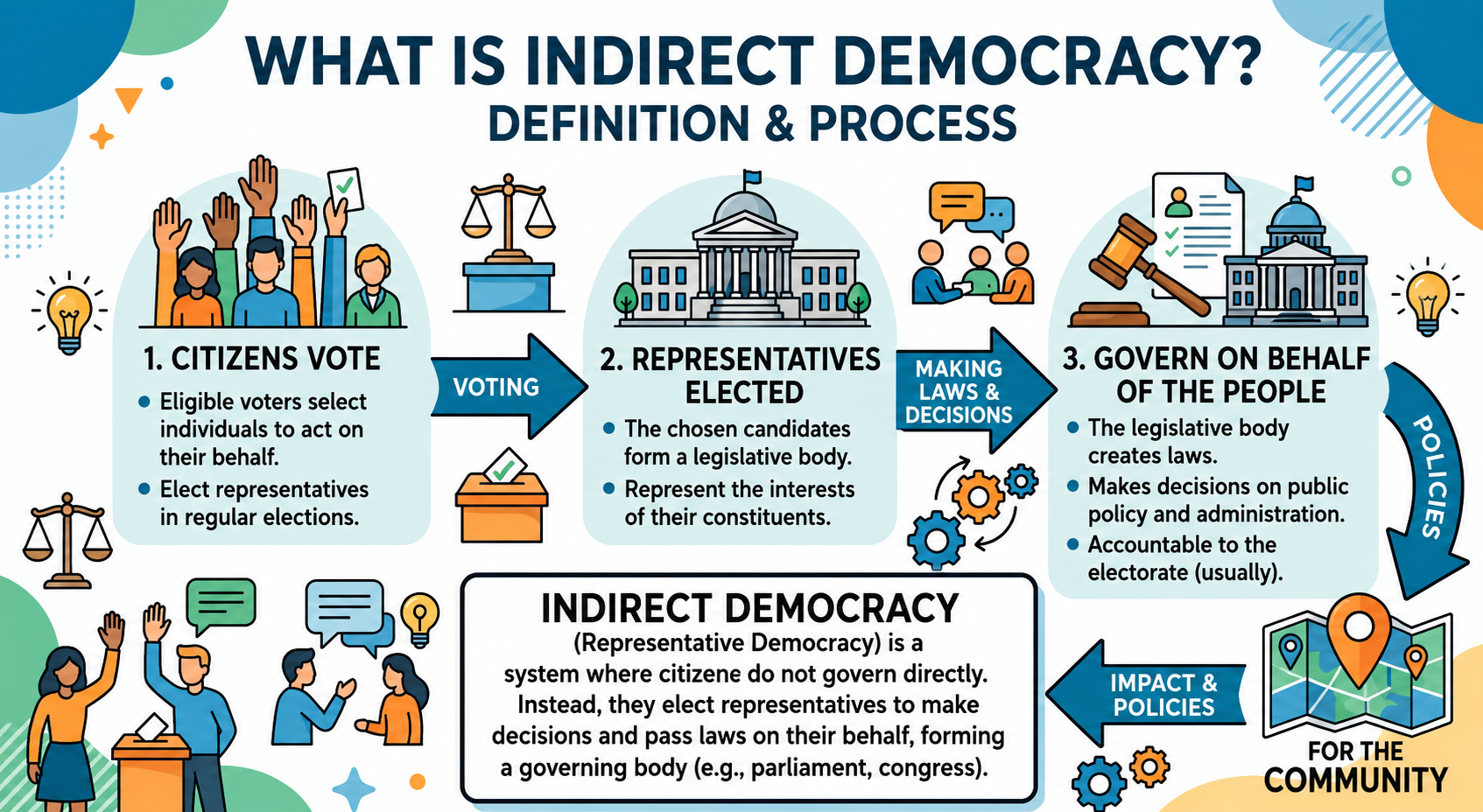
The indirect democracy definition describes a system of government in which citizens do not directly participate in making laws or policies but instead elect representatives who act on their behalf. These elected officials are responsible for debating, creating, and implementing laws within legislative bodies such as parliaments or congresses. This system allows large populations to participate in governance efficiently, as it would be impractical for every citizen to vote on every policy decision in modern states. Indirect democracy is also commonly referred to as representative democracy because it relies on elected individuals to represent the will of the people.
This form of democracy plays a crucial role in modern political systems because it balances citizen participation with practical governance. Through regular elections, people have the power to choose or replace their leaders, ensuring accountability in the political process. The indirect democracy definition highlights how this structure helps maintain order, stability, and effective decision-making in countries with large and diverse populations, where direct participation by all citizens would be difficult to manage.
Key Features of Indirect Democracy
Indirect democracy operates through several key features that define how the system functions in real-world governance. One of the most important elements involves the election of representatives, where citizens vote for individuals who then make decisions on their behalf. These representatives must reflect the interests, needs, and concerns of the people who elect them. This structure allows citizens to influence government decisions without directly participating in every legislative process. The indirect democracy definition closely links to this representative structure, which helps keep governance organized and manageable in large societies.
Another important feature is accountability, which ensures that elected officials remain answerable to the public. If representatives fail to perform effectively, citizens can replace them in the next election cycle. This system also includes regular elections, freedom of expression, and political participation, which strengthen democratic values. Together, these features create a balanced system where citizens maintain control over governance while allowing professionals to handle complex policy decisions efficiently.
How Indirect Democracy Works in Practice
Indirect democracy works through a structured process where citizens participate mainly by voting in elections, and elected representatives handle decision-making. The indirect democracy definition becomes clearer in practice because citizens first choose their leaders during local, regional, or national elections. These elected individuals then form legislative bodies such as parliaments or congresses, where they discuss national issues, propose laws, and make policy decisions on behalf of the public. This system ensures that governance continues smoothly even in countries with large populations, where direct decision-making would be too complex.
Once elected, representatives are expected to act in the interest of their constituents while balancing national priorities. They participate in debates, vote on legislation, and work within political parties to shape government policies. Citizens maintain influence by monitoring their leaders’ performance and voting them out in future elections if they do not meet expectations. This cycle of election and accountability forms the practical foundation of indirect democracy and ensures continuous public participation in governance through representative systems.
Advantages of Indirect Democracy
Indirect democracy offers several important advantages that make it one of the most widely used systems of governance in the world. One major benefit is efficiency, as the indirect democracy definition allows elected representatives to handle complex decision-making instead of requiring every citizen to vote on every issue. This structure saves time and ensures that laws and policies are created by individuals who have the expertise and experience needed to understand national and international issues.
Another key advantage is stability and accountability. Since citizens elect their representatives through regular elections, they can replace leaders who do not perform well or fail to meet public expectations. This creates a system of responsibility where politicians must remain responsive to the needs of the people. Additionally, indirect democracy encourages political participation, protects individual freedoms, and supports large-scale governance in diverse societies, making it highly effective for modern nation-states.
Disadvantages of Indirect Democracy
Indirect democracy also has certain limitations that can affect how effectively it represents the will of the people. One major drawback is the possibility of misrepresentation, where elected officials may not always act according to the true interests of their voters. While the indirect democracy definition emphasizes representation, in practice politicians may prioritize party goals, personal interests, or political agendas over public needs, which can weaken trust in the system.
Another disadvantage is the reduced level of direct public participation in decision-making. Citizens only influence government policies during elections, which may occur after several years. This gap can make people feel disconnected from the political process. Additionally, political campaigns can sometimes be influenced by money, media, or misinformation, which may affect election outcomes. These challenges show that while indirect democracy is practical for large societies, it is not without flaws that require constant oversight and improvement.
Real-World Examples of Indirect Democracy
Many countries around the world operate under systems that reflect the indirect democracy definition, where citizens elect representatives to make decisions on their behalf. One of the most well-known examples is the United States, where citizens vote for members of Congress and the President through an electoral system. These elected officials then create laws, manage national policies, and represent the interests of the public at different levels of government.
Another strong example is India, which functions as the world’s largest democratic system. Citizens vote for representatives in the Lok Sabha and state assemblies, who then form the government and make policy decisions. Similarly, countries like the United Kingdom, Canada, and Australia also follow parliamentary systems where elected representatives govern on behalf of the people. These real-world examples show how indirect democracy allows large and diverse populations to participate in governance efficiently through elected leadership.
Direct vs Indirect Democracy Comparison
Direct democracy and indirect democracy represent two different ways of involving citizens in governance. The indirect democracy definition focuses on electing representatives who make decisions on behalf of the people, while direct democracy allows citizens to vote on laws and policies themselves. In direct democracy, every major decision requires public voting, which works best in small communities where participation is easier to manage. In contrast, indirect democracy suits large nations where direct involvement of every citizen in every decision would be impractical.
Another key difference lies in efficiency and scalability. Indirect democracy allows elected officials to specialize in policymaking, which improves the speed and quality of decisions in complex societies. Direct democracy gives citizens more control but can slow down decision-making due to the need for constant voting. Most modern countries prefer indirect democracy because it balances participation with practicality, ensuring that governance remains both representative and efficient while still giving citizens power through elections.
Conclusion
The indirect democracy definition explains a system where citizens choose representatives to make laws and govern on their behalf. This structure helps large countries function smoothly by combining public participation with efficient decision-making. Through regular elections, citizens maintain control over their government while elected officials handle complex policy issues. Indirect democracy remains one of the most widely used political systems because it balances representation, stability, and practicality in modern societies.
Overall, indirect democracy provides an organized way for citizens to influence governance without directly voting on every issue. While it has some limitations, such as potential misrepresentation, it continues to play a key role in maintaining democratic governance around the world.
FAQs
What is the indirect democracy definition?
It is a system where citizens elect representatives who make laws and decisions on their behalf.
Why is indirect democracy used in large countries?
Because it is more practical and efficient than direct voting by millions of citizens on every issue.
What is another name for indirect democracy?
It is also called representative democracy.
Which countries use indirect democracy?
Countries like the United States, India, the United Kingdom, and Canada use indirect democratic systems.
Visit for More information : Multiple Magazines