 Admin
Admin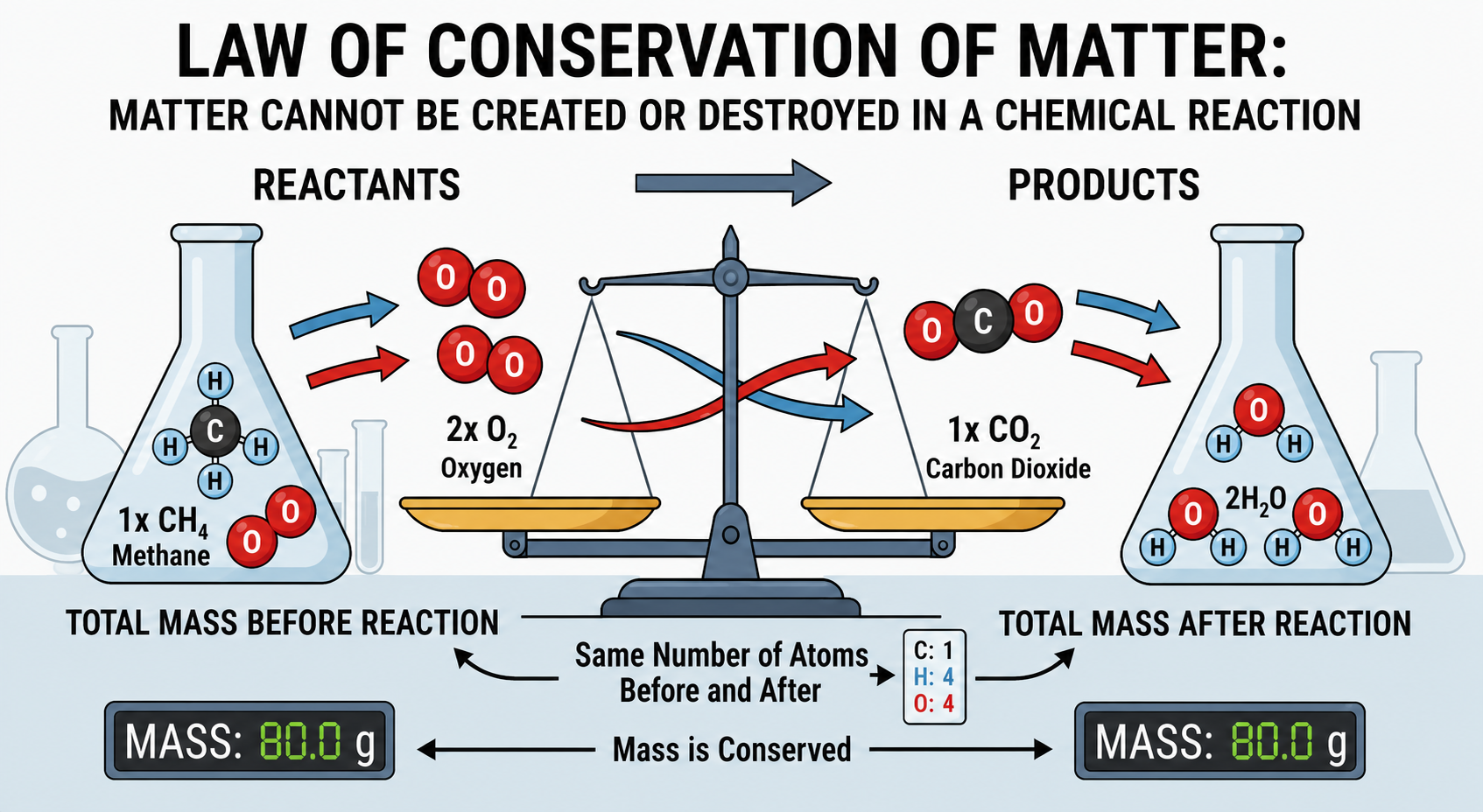
The law of conservation of matter is one of the most important principles in science and forms the foundation for understanding chemistry and physics. It explains that matter cannot be created or destroyed during ordinary physical or chemical changes. Instead, matter changes form, combines with other substances, or separates into different components while still maintaining the same total amount. This concept helps scientists explain why the mass of reactants in a chemical reaction equals the mass of the products formed. By understanding this law, students and researchers gain a better grasp of how substances interact and transform in both natural and controlled environment.
The importance of the law of conservation of matter extends far beyond the classroom. It plays a crucial role in scientific experiments, manufacturing processes, environmental studies, and everyday activities. Whether wood burns in a fireplace, ice melts into water, or ingredients mix during cooking, matter does not get lost—it simply changes its state or composition. This principle allows scientists to measure materials accurately, predict reaction outcomes, and develop technologies that rely on precise chemical calculations. As one of the core laws of modern science, it continues to shape our understanding of the physical world and the behavior of matter in many situations.
What Is the Law of Conservation of Matter?
The law of conservation of matter explains that in any physical or chemical process, the total amount of matter stays constant. Atoms are neither created nor destroyed; they simply rearrange into new forms. For example, when substances react in a chemical reaction, the atoms present before the reaction remain the same after the reaction, just arranged differently. This principle plays an important role in chemistry because it requires scientists to balance all chemical equations, showing equal numbers of each type of atom on both sides.
In simple terms, this law helps us understand that matter always stays conserved, even when it appears to change. Ice melts into water, or wood burns into ash and gases, but the total mass of the system remains the same if nothing enters or leaves. Scientists use this idea to track how substances change and to make accurate calculations in experiments and industrial processes. The law of conservation of matter therefore plays an essential role in explaining how the physical world works at both microscopic and macroscopic levels
History and Discovery of the Law
The law of conservation of matter developed through careful scientific observation during the 18th century, when scientists began questioning how substances change during chemical reactions. Before this discovery, many people believed that matter could simply disappear or appear out of nothing during reactions like burning or rusting. However, early experimental chemists measured substances more precisely and noticed that the total mass before and after a reaction stayed the same.
Antoine Lavoisier, often called the “father of modern chemistry,” made a major contribution to this law. He conducted controlled experiments using sealed containers to prove that matter stays conserved in chemical reactions. His precise measurements showed that although substances change form, their total mass remains constant. This discovery changed the foundation of chemistry and moved science away from old theories based on speculation toward modern experimental science based on measurement and evidenc
How the Law of Conservation of Matter Works
The law of conservation of matter works on the basic principle that atoms form the building blocks of all substances and scientists cannot create or destroy them in ordinary chemical reactions. Instead, atoms simply rearrange to form new substances. During a chemical reaction, bonds between atoms break and new bonds form, but the total number of each type of atom stays the same before and after the reaction. This is why scientists must always balance chemical equations to show equal atoms on both sides.
In practical terms, this means that if you start a reaction with a certain amount of matter, you end with the same amount, as long as the system stays closed. For example, when hydrogen and oxygen gases combine to form water, the atoms reorganize to create water molecules, but no one loses or gains atoms. This consistent behavior allows scientists to predict reaction outcomes and measure substances accurately in laboratories, industries, and natural pr
Real-Life Examples of the Law of Conservation of Matter
The law of conservation of matter appears in many everyday situations where substances change form but do not disappear. One simple example involves burning a candle. When a candle burns, the wax seems to vanish, but in reality, it converts into carbon dioxide gas, water vapor, and heat energy. The total matter still exists; it only changes its state and spreads into the air. Similarly, when ice melts into water, the substance changes from solid to liquid, but the total amount of matter stays the same.
Another common example involves cooking food. When people mix and heat ingredients, they cause chemical changes that create new flavors, textures, and substances. However, the total mass of the ingredients before cooking equals the mass of the cooked food afterward, as long as nothing gets lost during the process. Even in natural processes like rusting iron, iron reacts with oxygen in the air to form iron oxide, but the total matter involved in the reaction remains constant. This clearly demonstrates the continuous validity of this law in real life.
Importance of the Law in Chemistry and Science
The law of conservation of matter is extremely important in chemistry because it forms the foundation for understanding how chemical reactions work. It allows scientists to balance chemical equations correctly, ensuring that the same number of atoms exists on both sides of a reaction. Without this law, predicting the outcome of reactions or measuring substances accurately would not be possible. It also helps in calculating reactant quantities and determining how much product will be formed in experiments and industrial processes.
Beyond chemistry, this law is essential in many scientific fields such as physics, environmental science, and engineering. It helps researchers understand natural processes like the water cycle, combustion, and biological reactions in living organisms. In industries, it ensures efficient use of raw materials and reduces waste during production. The law of conservation of matter also plays a key role in environmental protection by helping scientists track pollutants and understand how substances move through ecosystems.
Common Misconceptions About Matter Conservation
Many people misunderstand the law of conservation of matter, especially when they observe everyday changes where substances seem to disappear or change completely. One common misconception says that burning or evaporation destroys matter. For example, when wood burns or a liquid evaporates, it may look like the material vanishes. In reality, the matter simply converts into gases or other forms that people cannot easily see, but the total mass stays unchanged in a closed system.
Another misunderstanding suggests that chemical reactions create entirely new matter from nothing. In truth, all atoms involved in a reaction already exist before the reaction begins; they only rearrange into new combinations. Even in dramatic reactions like explosions, matter stays conserved, although it spreads out rapidly or changes form. These misconceptions often arise because people do not account for invisible gases or changes in state, but scientific measurement consistently confirms that the law of conservation of matter always
Applications in Everyday Life and Industry
The law of conservation of matter is widely applied in everyday life, even when people do not realize it. In cooking, for example, chefs rely on this principle to measure ingredients accurately so that recipes turn out as expected. When baking a cake, the flour, sugar, eggs, and other ingredients do not disappear during cooking; instead, they combine and transform into a new structure while keeping the total mass nearly the same. This practical understanding helps in maintaining consistency in food preparation and reduces waste in kitchens.
In industries, this law is essential for manufacturing, construction, and chemical production. Factories use it to calculate exact amounts of raw materials needed to produce goods efficiently. In environmental science, it helps track pollutants and manage waste by understanding how substances move through air, water, and soil. Even in healthcare and pharmaceuticals, precise chemical measurements depend on this law to ensure safe and effective drug production. The law of conservation of matter therefore plays a vital role in improving efficiency, safety, and sustainability across multiple fields.
Conclusion
The law of conservation of matter acts as a fundamental scientific principle that explains how matter behaves during physical and chemical changes. It clearly shows that matter does not get created or destroyed; it only changes form through the rearrangement of atoms. This simple yet powerful idea helps scientists understand chemical reactions, balance equations, and measure substances accurately in both laboratory and real-world situations. From everyday activities like cooking and burning fuel to large-scale industrial processes, this law stays consistently applicable and reliable.
Overall, the law of conservation of matter plays an essential role in understanding how the physical world works. It connects many areas of science, including chemistry, physics, environmental studies, and engineering. By recognizing that matter always stays conserved, we gain a clearer understanding of natural processes and human-made systems. This principle not only supports scientific discovery but also improves efficiency, safety, and sustainability in everyday life and industry.
FAQs
What is the law of conservation of matter in simple words?
The law of conservation of matter explains that matter cannot create or destroy; it only changes from one form to another during physical or chemical changes.
Who discovered the law of conservation of matter?
Scientists mainly credit Antoine Lavoisier for this law, and he proved through experiments that mass stays constant during chemical reactions.
Does the law of conservation of matter apply in everyday life?
Yes, it applies in everyday life. For example, when wood burns or people cook food, matter does not get lost but changes into different forms.
Why is the law of conservation of matter important?
It is important because it helps scientists balance chemical equations, predict reaction results, and accurately measure substances in science and industry.
Visit for More information : Multiple Magazines