 Admin
Admin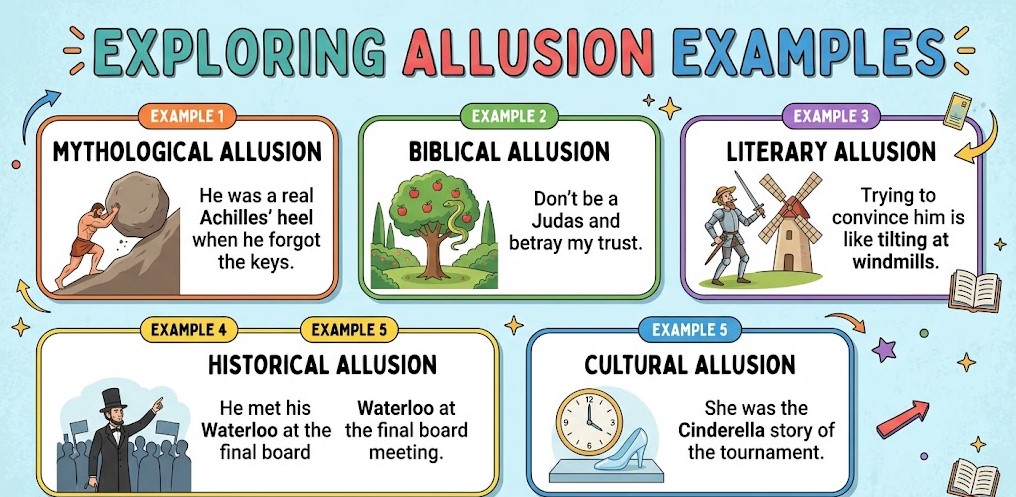
When we study literature and writing, the term allusion examples refers to indirect references made to famous people, stories, events, or cultural ideas. Instead of explaining something directly, writers use allusions to connect their ideas with something already known by the reader, which makes the message more meaningful and engaging. This technique helps create deeper understanding without long explanations and makes writing more creative and impactful.
In simple terms, allusion examples help readers link new ideas with familiar knowledge. For example, when someone says “He met his Waterloo,” they are referring to Napoleon’s final defeat rather than a literal place. Such expressions allow writers and speakers to communicate complex ideas in a short and effective way. Because of this, allusions appear frequently in literature, speeches, poetry, and even everyday conversation.
Writers use allusions to add emotional depth and cultural meaning to their work. Instead of describing everything in detail, they rely on shared references that readers can recognize. This makes understanding richer and more engaging, which is why learning allusion examples is important for students and anyone studying English language and literature.
Meaning of Allusion in Literature
An allusion in literature refers to an indirect reference to a person, place, event, or work of art that the writer expects the reader to recognize. Instead of explaining the reference in detail, the writer uses a short mention that connects the text to a larger idea or well-known story. This technique allows authors to add deeper meaning without interrupting the flow of their writing.
In literature, allusion examples help create layers of meaning that enrich the reader’s experience. For instance, a writer might mention “Pandora’s box” to suggest that a small action has led to unexpected problems. Such references rely on the reader’s prior knowledge of myths, history, religion, or popular culture. Because of this, allusions make writing more engaging and intellectually stimulating.
Writers use allusions to build stronger emotional and cultural connections with their audience. By referencing familiar stories or events, they can express complex ideas in a simple phrase. This technique is widely used in poetry, novels, and speeches to make language more powerful and memorable.
Types of Allusions with Examples
Allusions can be categorized into different types depending on the source they reference. Each type adds a unique layer of meaning to writing and helps readers connect ideas more easily. Understanding these categories makes it easier to identify and use allusion examples correctly in literature and everyday language.
In writing, authors use different kinds of allusions such as biblical, mythological, historical, and modern cultural references. These types allow writers to communicate complex ideas in a simple and impactful way. For example, a biblical allusion may refer to a story from the Bible, while a mythological allusion may come from Greek or Roman myths. Each type carries its own symbolic meaning that enriches the text.
Below is a simple table showing the main types of allusions with clear examples:
| Type of Allusion | Example Sentence | Meaning |
|---|---|---|
| Biblical Allusion | He is a Good Samaritan. | A helpful and kind person |
| Mythological Allusion | She has the strength of Hercules. | Extremely strong or powerful |
| Historical Allusion | He met his Waterloo in exams. | A final defeat or failure |
| Literary Allusion | This place feels like a Garden of Eden. | A peaceful, perfect place |
| Pop Culture Allusion | He is a real Romeo. | A romantic or loving person |
These allusion examples show how writers use well-known references to make their ideas more expressive and meaningful.
Common Allusion Examples in Sentences
Common allusion examples in sentences help readers understand how writers and speakers use indirect references in everyday communication. These allusions do not explain the reference directly; instead, they rely on shared cultural or historical knowledge to convey meaning quickly and effectively. This makes sentences more expressive and engaging without adding extra explanation.
Writers often use allusions in simple sentences to add depth and emotion. For example, saying “He is a real Einstein in mathematics” indirectly refers to Albert Einstein and suggests that the person is very intelligent. Similarly, phrases like “She opened Pandora’s box” refer to Greek mythology and imply that an action has led to unexpected problems. These references make communication more powerful and memorable.
Below are some commonly used allusion examples in sentences:
- He is a real Einstein in science.
- She became the Cinderella of the family.
- This problem feels like a Pandora’s box.
- He met his Waterloo in the final match.
- She works like a Trojan every day.
These examples show how allusions help compress meaning into a short phrase while still conveying a deeper message. Instead of long explanations, a single reference can communicate emotion, history, or character traits effectively.
Biblical Allusion Examples Explained
Biblical allusions are references to stories, characters, or events from the Bible that writers use to express deeper meanings in a short and symbolic way. These allusion examples are very common in literature, speeches, and everyday language because biblical stories are widely known and carry strong moral or emotional significance. Writers use them to add seriousness, depth, or moral lessons to their work without lengthy explanations.
In many cases, biblical allusions help describe human behavior or situations through familiar religious stories. For example, calling someone a “Good Samaritan” refers to a Bible story about a kind stranger who helped a wounded person. This phrase now represents any person who helps others selflessly. Similarly, “David and Goliath” is used to describe a situation where a small or weak opponent defeats a much stronger one. These references make communication more meaningful and culturally rich.
Below are some common biblical allusion examples:
- Good Samaritan – a kind and helpful person
- David and Goliath – an underdog defeating a stronger opponent
- Judas – someone who betrays others
- Garden of Eden – a place of perfect peace or beauty
- Prodigal Son – someone who returns after wasting opportunities
These allusions show how biblical references continue to shape modern language. They allow writers to express complex ideas in a simple and powerful way while connecting readers to well-known moral stories.
Historical and Mythological Allusion Examples
Historical and mythological allusions refer to indirect references made to important events, famous figures, or ancient myths that carry deeper symbolic meaning. These allusion examples help writers connect modern ideas with well-known stories from history or mythology, making their writing more meaningful and powerful. Readers who recognize these references can understand the message more quickly and deeply without additional explanation.
Historical allusions often refer to real events or people from the past. For example, saying someone “met their Waterloo” refers to Napoleon’s final defeat, symbolizing a complete failure or downfall. Similarly, mentioning “crossing the Rubicon” refers to Julius Caesar’s irreversible decision, which represents a point of no return. These references help writers express serious ideas in a short and impactful way.
Mythological allusions come from ancient Greek, Roman, and other mythologies. For example, calling someone “Herculean” refers to Hercules and suggests great strength or effort. Another example is “Achilles’ heel,” which refers to a single weakness in an otherwise strong person or system. These myth-based allusion examples add depth and imagination to writing.
Below are some common historical and mythological allusions:
- Waterloo – complete defeat or failure
- Crossing the Rubicon – irreversible decision
- Hercules – great strength or effort
- Achilles’ heel – a hidden weakness
- Trojan Horse – hidden danger or trick
These references enrich language by linking modern expressions with powerful stories from history and mythology, making communication more vivid and expressive.
Modern Pop Culture Allusion Examples
Modern pop culture allusions refer to indirect references made to movies, celebrities, songs, TV shows, or popular cultural figures. These allusion examples are widely used in today’s writing, speeches, and social media because they connect easily with readers who are familiar with current entertainment and trends. Writers use them to make their messages more relatable, engaging, and easy to understand for modern audiences.
Pop culture allusions help simplify complex ideas by linking them to well-known characters or situations. For example, calling someone a “real Sherlock Holmes” refers to the famous detective character and suggests strong problem-solving skills. Similarly, describing a person as a “Romeo” connects to Shakespeare’s character and implies romantic behavior. These references make communication more expressive and emotionally engaging.
In modern writing, allusions are not limited to classical literature or history. Instead, they often include references from films, music, sports, and internet culture. This makes language feel more current and relatable, especially for younger audiences who actively consume pop culture content. These allusion examples help bridge the gap between formal writing and everyday communication.
Below are some common modern pop culture allusions:
- Sherlock Holmes – a highly observant and intelligent person
- Romeo – a romantic lover
- Superman – someone with great strength or abilities
- Cinderella story – an unexpected success story
- Herculean task (modern use) – a very difficult job or challenge
These references show how modern allusions make language more vivid by connecting ideas to familiar cultural icons and stories.
Importance of Using Allusions in Writing
Allusions play an important role in writing because they help express complex ideas in a simple and meaningful way. These allusion examples allow writers to connect their message with well-known stories, historical events, or cultural references. Instead of explaining everything in detail, a single allusion can communicate deeper meaning quickly and effectively, making the writing more powerful and engaging.
Writers use allusions to create emotional depth and strengthen the connection with readers. When a reader recognizes a reference, it creates an instant understanding and adds extra layers of meaning to the text. For example, using a reference like “Pandora’s box” or “Good Samaritan” immediately brings a rich background of stories and ideas, which enhances the reader’s experience. This technique also makes writing more interesting and memorable.
Another important benefit of allusions is that they improve the quality of communication by making language more expressive and concise. Instead of long explanations, writers can use short references that carry deep meaning. These allusion examples also help develop critical thinking skills in readers, as they must recognize and interpret the references. Overall, allusions make writing more creative, meaningful, and impactful.
Conclusion
Allusions are a powerful literary tool that help writers express deeper meanings through indirect references. The study of allusion examples shows how language becomes more creative, expressive, and meaningful when writers connect ideas to well-known stories, historical events, myths, or cultural icons. Instead of long explanations, a simple reference can carry strong emotional and intellectual impact, making communication more effective and engaging.
From biblical and historical references to modern pop culture examples, allusions enrich writing by adding layers of meaning that readers can easily recognize and interpret. They not only improve literary quality but also make content more interesting and memorable. Understanding how allusions work helps students, writers, and readers better appreciate literature and everyday language.
FAQs
What is an allusion in simple words?
An allusion is an indirect reference to a famous person, event, story, or place.
What are common allusion examples?
Examples include “Good Samaritan,” “Achilles’ heel,” and “Pandora’s box.”
Why do writers use allusions?
Writers use allusions to express ideas quickly and add deeper meaning to their writing.
Are allusions used in everyday language?
Yes, people often use allusions in daily conversation, movies, and social media.
Visit for More information : Multiple Magazines