 Admin
Admin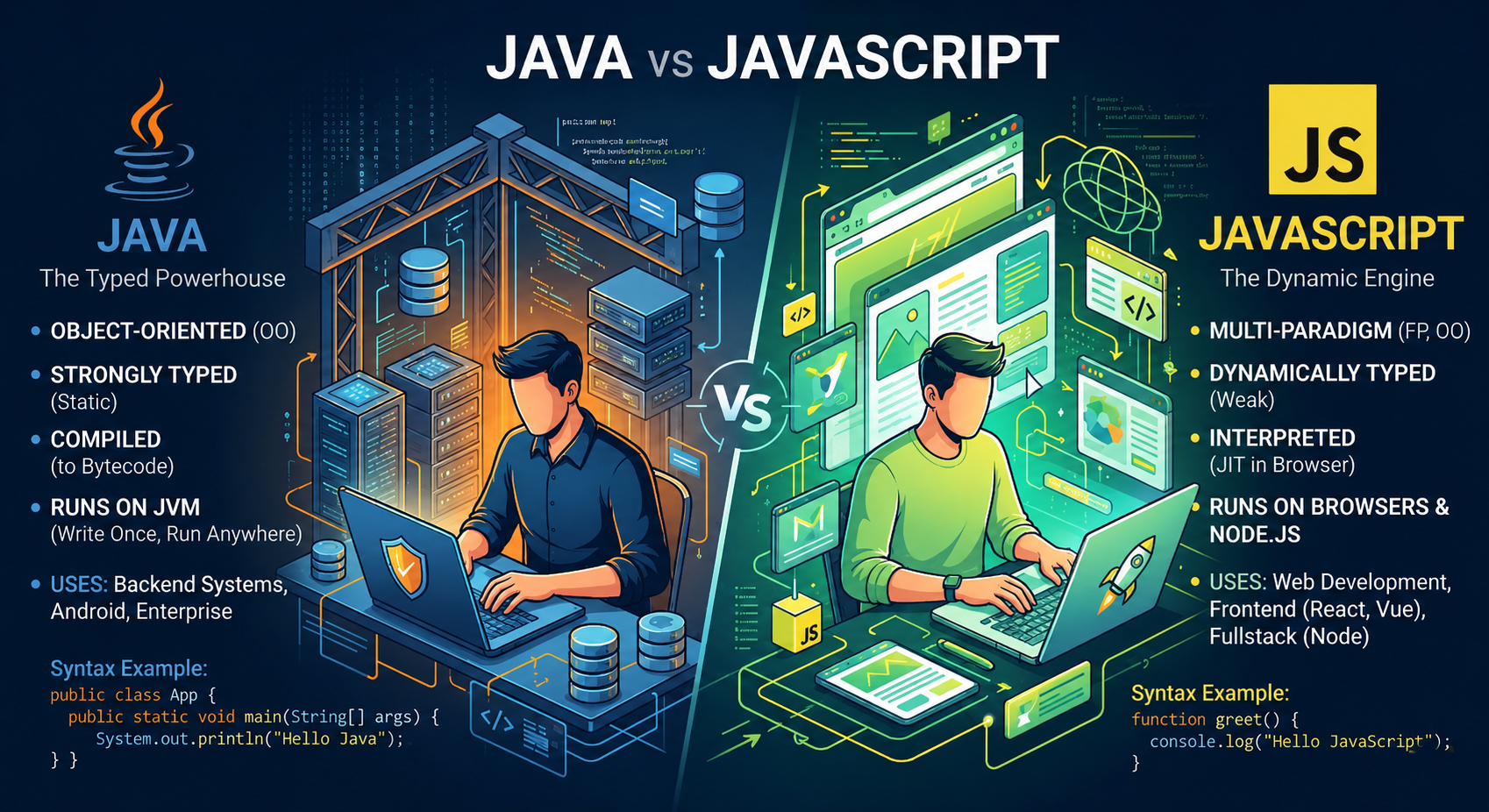
Java is a high-level, object-oriented programming language that developers widely use to build secure, scalable, and high-performance applications. It first appeared in the mid-1990s and follows the principle of “write once, run anywhere,” which means Java programs can run on any device that has the Java Virtual Machine installed. This feature makes Java one of the most portable and reliable programming languages in the software development world. Developers commonly use Java in backend development, mobile applications (especially Android apps), enterprise systems, and large-scale cloud-based platforms where stability and performance matter most.
One of the biggest strengths of Java is its strong structure and strict syntax rules, which help developers write clean and error-free code. It uses static typing, which allows the compiler to catch errors during the compilation phase instead of runtime, improving overall software reliability. Java also supports multithreading, automatic memory management through garbage collection, and offers a vast ecosystem of libraries and frameworks like Spring and Hibernate, which speed up development and improve efficiency. Because of these features, large companies trust Java for mission-critical systems.
In real-world usage, Java plays a major role in powering banking systems, e-commerce platforms, and Android mobile applications. Its ability to handle heavy workloads and secure transactions makes it a preferred choice for enterprise-level development. Many organizations choose Java when they need long-term stability and cross-platform compatibility, making it a cornerstone technology in the software industry.
What is JavaScript? (Overview, Features, Uses)
JavaScript is a lightweight, high-level scripting language that developers mainly use to create interactive and dynamic content on websites. Unlike Java, which focuses more on large-scale applications, JavaScript primarily serves web development and runs directly in the browser without requiring compilation. Over time, developers have also expanded its use beyond browsers with environments like Node.js, which allows server-side programming as well. This flexibility has made JavaScript one of the most important languages in modern web development.
One of the key features of JavaScript is its dynamic typing system, which allows variables to change types during runtime, making it more flexible and easier to write for beginners. It follows an event-driven and prototype-based programming approach, which helps developers create responsive user interfaces, animations, and real-time updates on websites. JavaScript also integrates seamlessly with HTML and CSS, forming the core technologies of the web. Modern frameworks like React, Angular, and Vue have further expanded its capabilities, enabling developers to build complex single-page applications efficiently.
In practical use, JavaScript is everywhere on the internet today. It powers interactive forms, live chat systems, dropdown menus, video players, and entire web applications like social media platforms and online tools. Its ability to run on almost every browser without additional setup makes it incredibly accessible and widely adopted. Because of its versatility and constant evolution, JavaScript continues to dominate front-end development and is also growing rapidly in backend and full-stack development environments.
Key Differences Between Java and JavaScript
The comparison of java vs javascript becomes much clearer when we look at their core differences in purpose, structure, and execution. Although their names are similar, developers built both languages for entirely different ecosystems. Developers mainly use Java for building standalone applications, mobile apps, and enterprise systems, while JavaScript mainly serves to make web pages interactive and dynamic. This fundamental difference is the first thing every developer should understand before choosing between them.
Another major difference lies in how both languages execute. Java works as a compiled language, meaning the compiler first converts the code into bytecode and then the Java Virtual Machine (JVM) executes it. This process makes Java highly stable and platform-independent. On the other hand, JavaScript works as an interpreted language that runs directly in the browser or through environments like Node.js. Because of this, JavaScript executes faster in development environments and allows developers to test and modify code in real time more easily.
There are also differences in typing systems and programming structure. Java uses static typing, which requires developers to declare a specific data type for variables, and the compiler detects errors during compilation. This approach reduces runtime issues and improves code safety. JavaScript uses dynamic typing, which gives developers more flexibility but also increases the chances of runtime errors. Additionally, Java follows a class-based object-oriented structure, whereas JavaScript uses a prototype-based model, which changes how objects and inheritance work.
| Feature | Java | JavaScript |
|---|---|---|
| Type | Compiled Language | Interpreted Language |
| Typing | Static | Dynamic |
| Execution | JVM (Java Virtual Machine) | Browser / Node.js |
| Structure | Class-based OOP | Prototype-based |
| Main Use | Enterprise, Android apps | Web development |
In summary, the java vs javascript differences highlight that Java is more suited for large, complex, and secure applications, while JavaScript is ideal for fast, interactive, and user-focused web experiences.
Performance, Syntax, and Learning Curve Comparison
When analyzing java vs javascript, developers often discuss performance as one of the most important factors. Java generally performs better in large-scale systems because it runs on the Java Virtual Machine (JVM), which improves performance through Just-In-Time (JIT) compilation. This makes Java highly efficient for backend systems, enterprise software, and applications that require heavy processing. However, this optimization also adds some overhead, which can make Java slightly slower to start compared to lightweight scripting languages.
JavaScript, on the other hand, focuses on fast execution within web environments. It runs directly in the browser using engines like V8 (used in Chrome), which makes it extremely fast for front-end operations such as animations, user interactions, and real-time updates. With the introduction of Node.js, developers also use JavaScript for backend tasks efficiently. However, for very complex and CPU-intensive operations, Java still maintains a performance advantage due to its structured runtime environment and optimized memory handling.
In terms of syntax, Java is more strict and structured. Developers must declare every variable with a specific data type, and the code must follow a class-based structure. This strictness helps reduce errors but can feel overwhelming for beginners. JavaScript, however, offers a more flexible and relaxed syntax. It allows dynamic typing and does not require strict class structures for basic programs, which helps beginners start coding quickly. This flexibility is one of the main reasons JavaScript has a faster learning curve for new developers.
The learning curve between java vs javascript is noticeably different. Java requires understanding of object-oriented programming concepts, memory management basics, and compilation processes, which can take more time to master. JavaScript is easier to pick up initially because you can immediately see results in a browser without complex setup. However, mastering advanced JavaScript concepts like asynchronous programming, closures, and frameworks can also become challenging over time.
In short, Java is more structured and performance-oriented for large systems, while JavaScript is more flexible and beginner-friendly for web-based development, making each language suitable for different stages and goals in a developer’s journey.
Real-World Use Cases of Java vs JavaScript
The comparison of java vs javascript becomes much clearer when we look at how both languages are used in real-world applications. Each language has a distinct ecosystem where it performs best, and companies choose them based on project requirements, scalability, and user experience needs. Java is commonly used in backend-heavy systems, while JavaScript dominates the front-end and interactive web environment.
Java is widely used in enterprise-level applications where security, stability, and scalability are critical. Large financial institutions, banking systems, and insurance platforms rely on Java because it can handle complex transactions and large amounts of data reliably. It is also the primary language for Android app development, making it essential for mobile developers who want to build native Android applications. Additionally, Java is used in large backend systems, cloud-based platforms, and big data technologies like Apache Hadoop, where performance and reliability are key priorities.
JavaScript, on the other hand, plays a major role in modern web development. It is responsible for making websites interactive, responsive, and user-friendly. Almost every modern website uses JavaScript in some form, whether it is for form validation, animations, dynamic content loading, or real-time updates. With frameworks like React, Angular, and Vue, JavaScript is also used to build full-scale single-page applications (SPAs) such as social media platforms, dashboards, and e-commerce frontends. In addition, Node.js has expanded its use to backend development, allowing developers to build complete full-stack applications using JavaScript alone.
To better understand java vs javascript in real-world scenarios, consider this simple breakdown:
- Java is used in:
- Banking systems
- Android mobile apps
- Enterprise software
- Backend servers
- Big data processing systems
- JavaScript is used in:
- Interactive websites
- Web applications (SPAs)
- Front-end development
- Real-time chat apps
- Full-stack applications using Node.js
In conclusion, Java is preferred for large, secure, and performance-critical systems, while JavaScript is essential for creating dynamic and interactive user experiences on the web. Both languages dominate their respective domains, making them equally important in today’s software development industry.
Which One Should You Learn First?
Choosing between java vs javascript depends entirely on your career goals, the type of development you want to do, and how quickly you want to start building real projects. Both languages are powerful, but they serve different paths in the programming world, so the “best” choice is not universal—it is personal.
If your main interest is web development, especially front-end design and interactive user interfaces, then JavaScript is usually the better starting point. It allows beginners to see results quickly in the browser without complex setup, which helps build confidence early. With JavaScript, you can start creating websites, animations, and small applications almost immediately. As you progress, you can move into frameworks like React or Vue and even expand into backend development using Node.js, making it possible to become a full-stack developer using a single language.
On the other hand, if you are more interested in software engineering, mobile applications, or enterprise-level systems, Java may be the better choice. Java teaches strong programming fundamentals such as object-oriented programming, data structures, and memory management in a structured way. It is widely used in large companies, especially for backend systems and Android development, so learning Java can open doors to more traditional software engineering roles.
In terms of learning difficulty, JavaScript is generally easier for beginners because it has a simpler setup and more flexible syntax. Java, however, has a steeper learning curve but builds a stronger foundation in programming concepts. Many experienced developers suggest that learning Java first can make you a more disciplined programmer, while JavaScript helps you become more practical and project-focused quickly.
In short, when comparing java vs javascript, the decision comes down to your goal:
- Choose JavaScript if you want fast entry into web development and interactive UI work
- Choose Java if you want structured programming and backend or Android development
Both are highly in-demand skills, and learning either one can lead to strong career opportunities in the tech industry.
Conclusion
The discussion of java vs javascript clearly shows that both programming languages are powerful but serve completely different purposes in the software development world. Java is a robust, object-oriented language designed for building large-scale applications, enterprise systems, and Android apps. It focuses on stability, security, and performance, making it a trusted choice for long-term and complex projects.
JavaScript, on the other hand, is the backbone of modern web development. It brings websites to life by enabling interactivity, dynamic content, and real-time user experiences. From simple animations to full-scale web applications and even backend services with Node.js, JavaScript has become one of the most versatile languages in the tech industry.
When comparing java vs javascript, there is no single winner because each language dominates its own domain. Java is ideal for structured software engineering and backend-heavy systems, while JavaScript is essential for front-end development and modern web applications. The best choice depends entirely on your career goals and the type of projects you want to build.
In conclusion, both languages are highly valuable in today’s job market. Learning either Java or JavaScript can open strong career opportunities, and many developers eventually learn both to become more versatile and competitive in the tech industry.
FAQs
What is the main difference between Java and JavaScript?
The main difference is that Java is a compiled, object-oriented programming language used for large applications, while JavaScript is an interpreted scripting language mainly used for web development and interactivity.
Is Java easier than JavaScript?
JavaScript is generally easier for beginners because it has a simpler setup and more flexible syntax. Java is more structured and may take longer to learn, but it builds stronger programming fundamentals.
Can Java and JavaScript be used together?
Yes, they can be used together in full-stack development. Java is often used for backend systems, while JavaScript is used for front-end interfaces, allowing both to work in the same project.
Which is better for career growth: Java or JavaScript?
Both have strong career opportunities. Java is widely used in enterprise and Android development, while JavaScript dominates web development and modern full-stack applications. The better choice depends on your career goals.
Visit for More information : Multiple Magazines