 Admin
Admin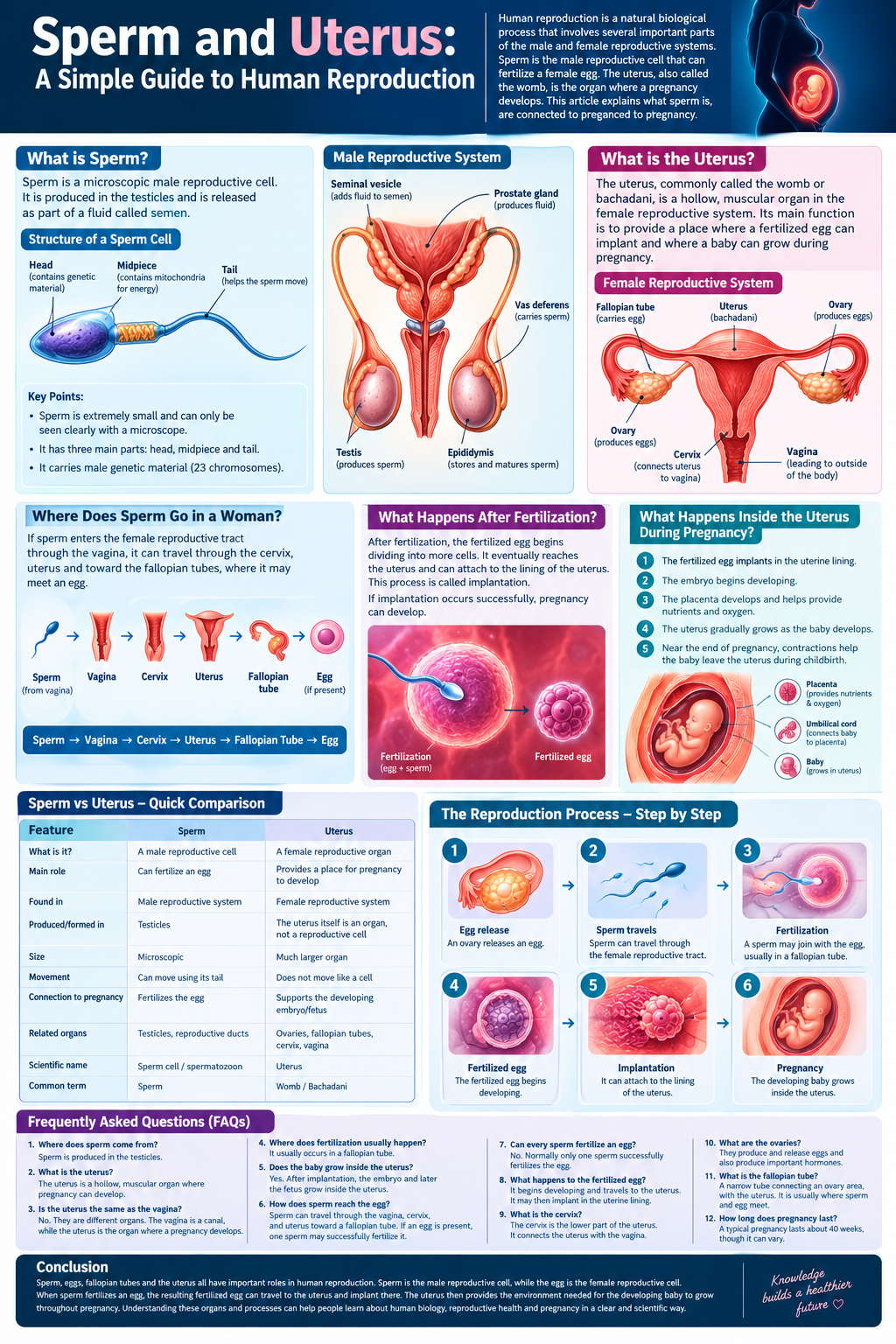
Human reproduction is a natural biological process that involves several important parts of the male and female reproductive systems. Two important terms in this process are sperm and the uterus.
Sperm is the male reproductive cell that can fertilize a female egg. The uterus, also called the womb, is the organ in the female reproductive system where a pregnancy develops.
This article explains what sperm is, where it travels, what the uterus does, and how these parts are connected to pregnancy.
| Feature | Sperm | Uterus |
|---|
| What is it? | A male reproductive cell | A female reproductive organ |
| Main role | Can fertilize an egg | Provides a place for pregnancy to develop |
| Found in | Male reproductive system | Female reproductive system |
| Produced/formed in | Testicles | The uterus itself is an organ, not a reproductive cell |
| Size | Microscopic | Much larger organ |
| Movement | Can move using its tail | Does not move like a cell |
| Connection to pregnancy | Fertilizes the egg | Supports the developing embryo/fetus |
| Related organs | Testicles, reproductive ducts | Ovaries, fallopian tubes, cervix, vagina |
| Scientific name | Sperm cell / spermatozoon | Uterus |
| Common term | Sperm | Womb / Bachadani |
What Is Sperm?
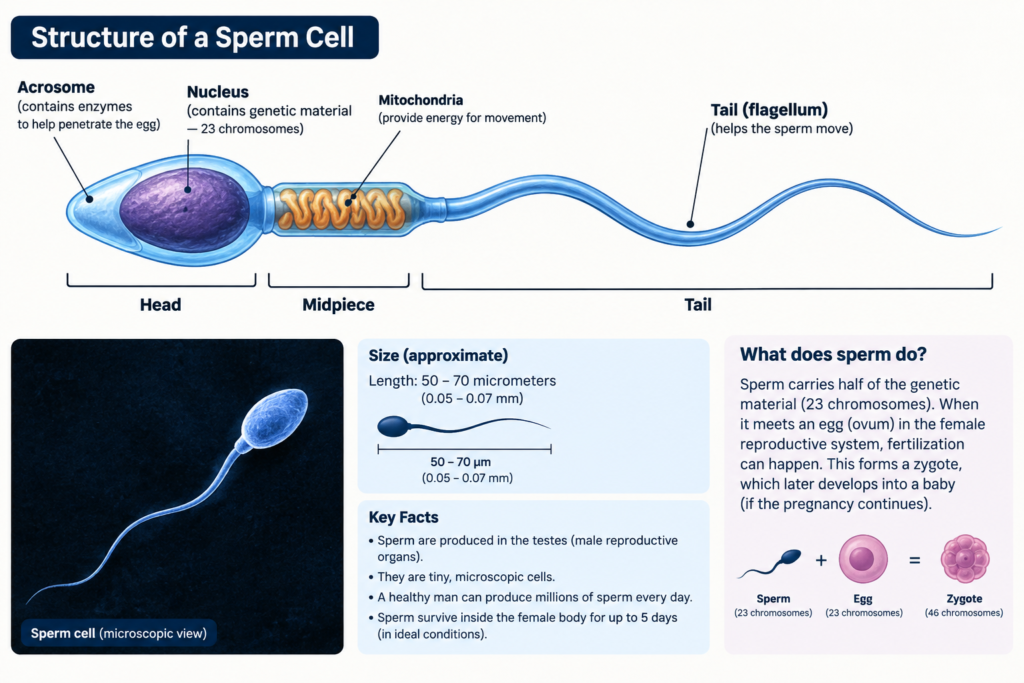
Sperm is a microscopic male reproductive cell. It is produced in the testicles and is released as part of a fluid called semen.
A sperm cell has three main parts:
- Head: Contains genetic material and helps the sperm enter the egg.
- Midpiece: Contains mitochondria that provide energy.
- Tail: Helps the sperm move forward.
Sperm cells are extremely small and can only be seen clearly with a microscope.
What Is the Uterus?
The uterus, commonly called the womb or bachadani, is a hollow, muscular organ in the female reproductive system.
Its main function is to provide a place where a fertilized egg can implant and where a baby can grow during pregnancy.
The uterus is connected with other reproductive organs, including:
- Ovaries: Produce eggs.
- Fallopian tubes: Carry the egg from the ovary toward the uterus and are usually where fertilization occurs.
- Cervix: The lower, narrow part of the uterus.
- Vagina: The canal connecting the cervix to the outside of the body.
| Step | What happens |
|---|
| 1. Egg release | An ovary releases an egg. |
| 2. Sperm travels | Sperm can travel through the female reproductive tract. |
| 3. Fertilization | A sperm may join with the egg, usually in a fallopian tube. |
| 4. Fertilized egg | The fertilized egg begins developing. |
| 5. Implantation | It can attach to the lining of the uterus. |
| 6. Pregnancy | The developing baby grows inside the uterus. |
How Do Sperm and Egg Meet?
During reproduction, sperm may enter the female reproductive tract through the vagina.
From there, sperm can travel through the cervix and uterus toward the fallopian tubes.
If an egg is present and a sperm successfully fertilizes it, fertilization occurs. The resulting fertilized egg then travels toward the uterus.
A simplified pathway is:
Sperm → Vagina → Cervix → Uterus → Fallopian Tube → Egg
What Happens After Fertilization?
After fertilization, the fertilized egg begins dividing into more cells. It eventually reaches the uterus and can attach to the lining of the uterus. This process is called implantation.
If implantation occurs successfully, pregnancy can develop.
During pregnancy, the uterus expands as the baby grows. The baby receives oxygen and nutrients through the placenta, while the umbilical cord connects the developing baby to the placenta.
What Happens Inside the Uterus During Pregnancy?
The uterus provides a protected environment for the developing baby.
Several important changes occur during pregnancy:
- The fertilized egg implants in the uterine lining.
- The embryo begins developing.
- The placenta develops and helps provide nutrients and oxygen.
- The uterus gradually grows as the baby develops.
- Near the end of pregnancy, contractions help the baby leave the uterus during childbirth.
Important Difference Between Sperm and Egg
Sperm and egg are both reproductive cells, but they are different.
| Sperm | Egg |
|---|---|
| Male reproductive cell | Female reproductive cell |
| Produced in the testicles | Produced in the ovaries |
| Very small | Much larger than sperm |
| Has a tail for movement | Does not have a tail |
| Carries male genetic material | Carries female genetic material |
When sperm and egg combine, they form a fertilized egg, which can develop into an embryo.
Conclusion
Sperm, eggs, fallopian tubes, and the uterus all have important roles in human reproduction. Sperm is the male reproductive cell, while the egg is the female reproductive cell. When sperm fertilizes an egg, the resulting fertilized egg can travel to the uterus and implant there.
The uterus then provides the environment needed for the developing baby to grow throughout pregnancy.
Understanding these organs and processes can help people learn about human biology, reproductive health, and pregnancy in a clear and scientific way.
Frequently Asked Questions (FAQs)
1. Where does sperm come from?
Sperm is produced in the testicles, which are part of the male reproductive system.
2. What is the uterus?
The uterus is a hollow, muscular organ in the female reproductive system where a pregnancy can develop.
3. Is the uterus the same as the vagina?
No. They are different organs. The vagina is a canal, while the uterus is the organ where a pregnancy develops.
4. Where does fertilization usually happen?
Fertilization usually occurs in a fallopian tube, when a sperm successfully joins with an egg.
5. Does the baby grow inside the uterus?
Yes. After implantation, the developing embryo and later the fetus grow inside the uterus during pregnancy.
6. How does sperm reach the egg?
Sperm can travel through the vagina, cervix, and uterus toward a fallopian tube. If an egg is present, one sperm may successfully fertilize it.
7. Can every sperm fertilize an egg?
No. Although many sperm may travel toward an egg, normally only one sperm successfully fertilizes the egg.
8. What happens to the fertilized egg?
The fertilized egg begins developing and travels toward the uterus. It may then implant into the uterine lining, allowing pregnancy to develop.
9. What is the cervix?
The cervix is the lower part of the uterus. It connects the uterus with the vagina.
10. What are the ovaries?
The ovaries are female reproductive organs that produce and release eggs. They also produce important reproductive hormones.
11. What is the fallopian tube?
A fallopian tube is a narrow tube connecting an ovary area with the uterus. It is usually the location where sperm and egg meet during fertilization.
12. How long does pregnancy normally last?
A typical pregnancy lasts about 40 weeks, counted from the first day of the last menstrual period, although normal pregnancies can vary in length.
Visit for More information : Multiple Magazines